Most organisations do not struggle to decide which technology they need. They struggle to fund it, deploy it, support it, and eventually retire it without turning each stage into a separate procurement exercise. A laptop refresh becomes a capital request. The capital request becomes a deferred project. The deferred project leaves teams working on ageing devices long after they should have been replaced.
Technology financing, or TechFin, emerged to address that pattern. Rather than treating the technology decision and the funding decision as two unrelated problems, a TechFin model brings them together under one structure, so organisations can access the IT equipment and services they need while spreading the cost over an agreed period.
What Is TechFin?
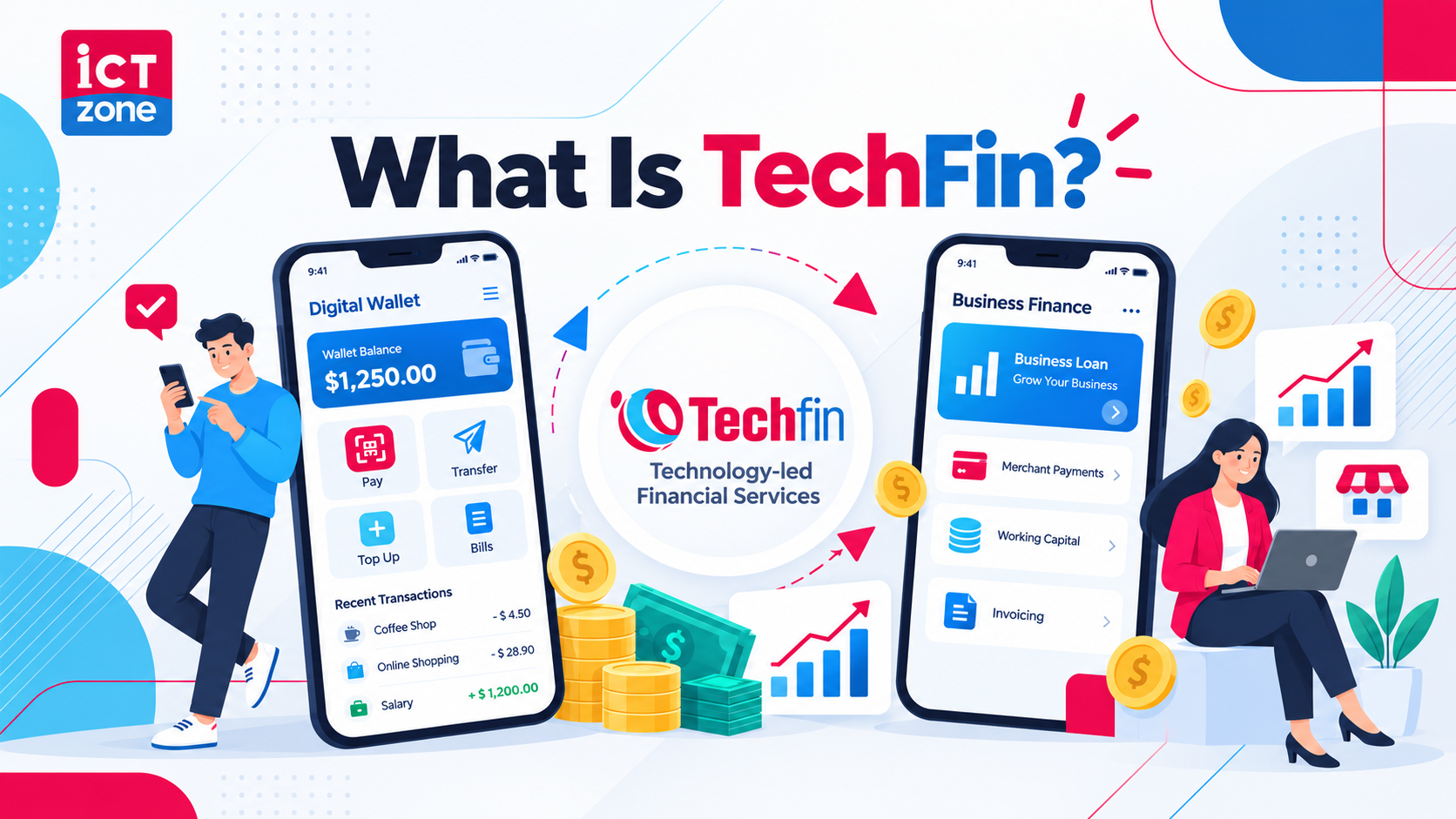
TechFin is a combination of technology and financing solutions that provides organisations with access to IT hardware, software and related services on a rental or leasing basis. Instead of purchasing equipment outright and then arranging separate support, the organisation gains access to a complete technology solution that is funded over time and supported by maintenance services for the duration of the agreement. Contract tenures typically range from 3 to 5 years, offering cost predictability and budget efficiency.
This significantly differs from conventional financing. A bank loan funds an asset and nothing more. A TechFin arrangement typically bundles the equipment, the software, the deployment, the maintenance, and the eventual recovery into a single commercial structure with a predictable periodic cost.
The practical effect is that technology stops being a series of capital events and becomes an operating service that can be planned, adjusted and renewed.
How Is TechFin Different from Traditional IT Procurement?
Traditional procurement separates the technology purchase from everything that surrounds it. An organisation buys devices from a supplier, arranges financing from a lender if required, engages a separate party for maintenance, and then faces the question of disposal when the equipment reaches the end of its useful life. Each step involves a different vendor, a different contract and a different internal approval.
A TechFin model compresses that sequence. Because the provider is responsible for both the technology and the funding, the organisation works with one counterparty across the full lifecycle: responsible handling of devices which includes refurbishment or disposal, in conjunction with sustainability and compliance requirements. This can reduce the administrative burden on procurement and finance teams, and it can make the true cost of technology easier to forecast.
The distinction matters most for organisations with large or distributed device fleets. When a refresh cycle involves hundreds of units across several locations, coordinating multiple vendors often consumes more internal resources than the technology decision itself.
Why Has TechFin Gained Ground in Malaysia?
Malaysian organisations across the public and private sectors have been under pressure to modernise while managing budgets carefully. Government agencies work within annual allocation structures. Enterprises face competing capital priorities. Smaller organisations may simply lack the balance sheet to fund a full refresh at once.
The ACE Market listing of ICT Zone Asia Berhad in June 2025 reflects how established this model has become. A company founded in 2000 as an IT hardware supplier has evolved over more than two decades into an integrated technology and financing provider serving government agencies, enterprises, publicly listed companies, SMEs and educational institutions.
That evolution mirrors the wider market. As technology refresh cycles shorten and device counts grow, the question for many organisations is no longer whether they can afford new equipment. It is whether the purchasing model itself still makes sense.
What Does ICT Zone’s TechFin Model Cover?
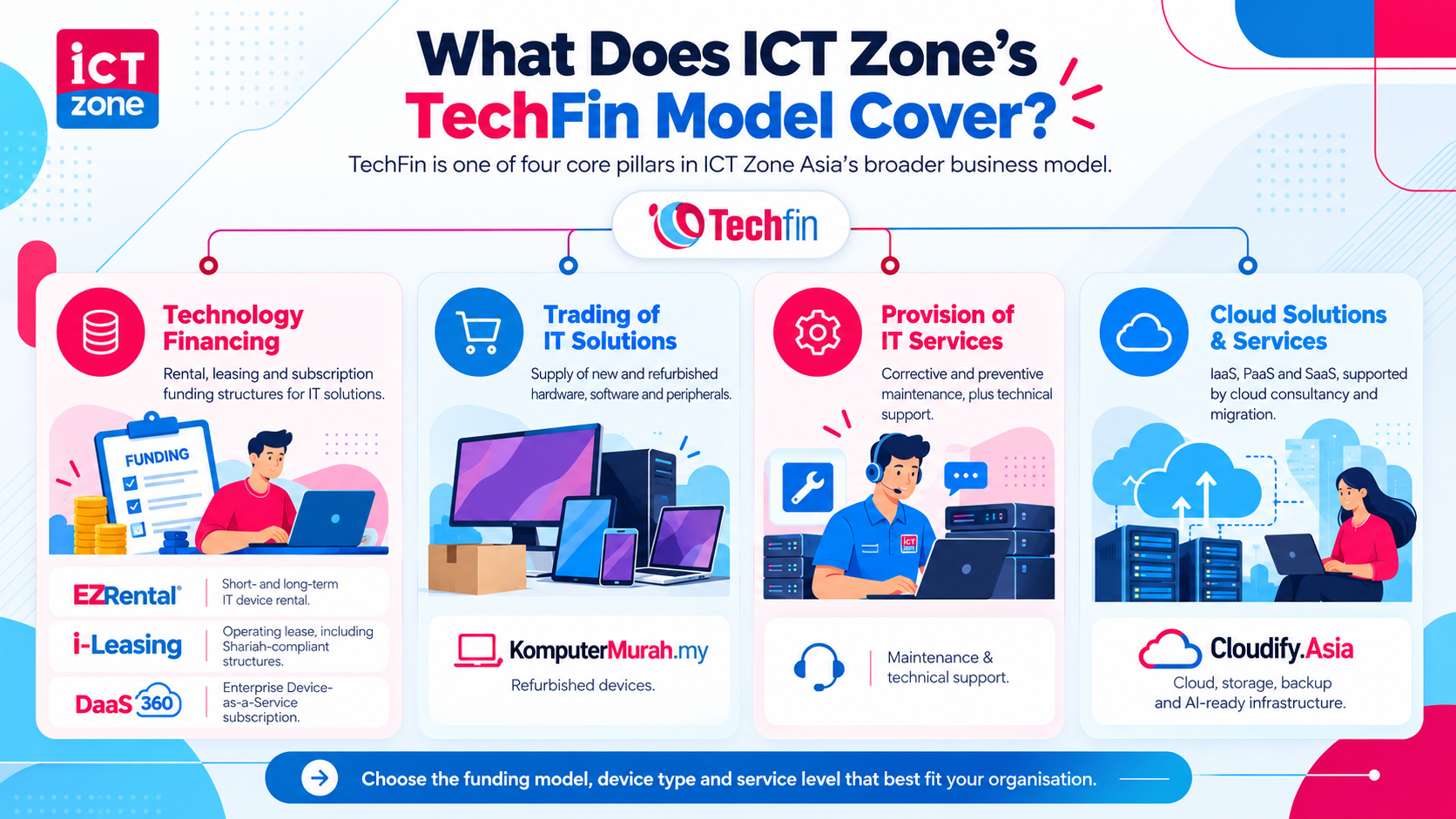
ICT Zone Asia’s business is structured around four core pillars, with Technology Financing forming only one part of the Group’s broader business activities. The four pillars are Technology Financing, Trading of IT Solutions, Provision of IT Services, and Provision of Cloud Solutions and Services.
Technology Financing provides funding structures that enable organisations to access IT solutions through rental, leasing arrangements. Trading of IT Solutions involves the supply of new and refurbished hardware, software and peripherals. Provision of IT Services includes corrective and preventive maintenance, as well as technical support. Provision of Cloud Solutions and Services encompasses Infrastructure as a Service, Platform as a Service and Software as a Service, supported by cloud consultancy and migration services.
These pillars are delivered through a set of focused brands. EzRental provides short-term and long-term IT device rental. i-Leasing provides corporate IT leasing on an operating lease basis, with Shariah-compliant structures suitable for Islamic financial institutions and conventional enterprises. DaaS 360 provides an enterprise Device-as-a-Service subscription. KomputerMurah.my supplies refurbished devices, while Cloudify.Asia delivers cloud, storage, backup and AI-ready infrastructure.
Together, the pillars and brands allow an organisation to select the funding model, the device type and the service level that match its requirements rather than accepting a single fixed package.
How Does TechFin Change the Way Organisations Pay for Technology?
The most immediate change is the shift from a large upfront payment to a recurring operating cost. Rather than requesting capital expenditure for a full refresh, organisations can align technology access with workforce size and operational need, paying a monthly fee that covers equipment and services together.
This can improve budget predictability. Instead of irregular capital requests that compete with other business priorities, technology becomes a line item that finance teams can plan around. For organisations managing seasonal headcount, project-based teams or rapid expansion, the ability to scale device counts up or down can also reduce the risk of paying for capacity that is not being used.
The accounting treatment will depend on the structure chosen. Operating lease arrangements, rental agreements and subscription models each carry different implications, so organisations should review the treatment with their finance advisors before committing.
Who Should Consider a TechFin Approach?
A TechFin model becomes relevant when technology management starts creating friction. A growing SME may need to equip new staff without repeatedly restarting a procurement process. A government agency may require a structured approach to lifecycle planning, security and recovery across multiple departments. An enterprise with offices in several states may need consistent device standards and support coverage without negotiating separate agreements in each location.
Organisations with Environmental, Social and Governance (ESG) commitments may also find the model useful. Because the provider retains responsibility for end-of-use recovery, the environmental dimension of technology disposal becomes part of the agreement rather than an unresolved afterthought. ICT Zone holds ISO 14001:2015 environmental management certification and the MyHIJAU mark for DaaS 360, and its [1] [2] Carbon Neutral Computing Services have reduced more than 428 tonnes of carbon dioxide emissions to date.
The common thread is not organisation size. It is whether the current approach to funding and managing technology is creating more work than it should.
How Does TechFin Support the Full Technology Lifecycle?
A comprehensive TechFin arrangement does not end when the devices are delivered. Because the provider remains responsible for the equipment throughout the contract, maintenance, monitoring, repair and replacement can be handled as part of the same agreement. When devices reach the end of their intended use, secure recovery and responsible disposal form part of the process rather than a separate project.
This continuity is where the model delivers most of its practical value. Organisations gain a clearer view of what technology they have, what condition it is in, what it is costing and when it should be refreshed, without assembling that picture from several unrelated vendor records.
Frequently Asked Questions: TechFin Malaysia
- Is TechFin the same as leasing?
Leasing can form part of a TechFin model, but the two are not identical. A lease funds the use of equipment, whereas a broader TechFin arrangement can also include software supply, deployment, maintenance, technical support, security management and end-of-use recovery under the same provider.
- Is TechFin suitable for government agencies?
It can be. Government organisations often manage complex device environments across multiple departments and locations, which can make a single accountable partner attractive. The appropriate structure will depend on procurement requirements, security standards and allocation cycles.
- Does TechFin mean giving up ownership of IT equipment?
Not necessarily. Many agreements provide the option to purchase the equipment at the end of the tenure, with the price determined by factors such as net book value, market price and device condition. Organisations should confirm the end-of-term options before signing.
- Can Shariah-compliant structures be arranged?
Yes. ICT Zone’s i-Leasing solution is Shariah-compliant, which makes it suitable for Islamic financial institutions as well as conventional enterprises that prefer that structure.
- Is TechFin only about reducing upfront cost?
Lower upfront expenditure is one benefit, but it is not the only one. Organisations also adopt the model to simplify procurement, gain lifecycle visibility, reduce internal IT workload and align technology decisions with sustainability objectives.
Rethink Technology Investment with ICT Zone
Modern organisations need more than access to laptops, desktops and servers. They need a way to fund, deploy, support and recover that technology without fragmenting the work across multiple vendors and multiple budgets.
ICT Zone Asia Berhad brings these requirements together through its TechFin model, combining technology financing, IT solutions trading, IT services and cloud solutions across four integrated business pillars, delivered through EzRental, i-Leasing, DaaS 360, KomputerMurah.my and Cloudify.Asia.
ICT Zone Asia Berhad addresses these requirements through four integrated business pillars: Technology Financing, Trading of IT Solutions, Provision of IT Services, and Provision of Cloud Solutions and Services. These offerings are delivered through its various business solutions and platforms, including EzRental, i-Leasing, DaaS 360, KomputerMurah.my and Cloudify.Asia, with TechFin forming part of its Technology Financing offering.
The result is a more predictable and more manageable way for Malaysian enterprises, government agencies and SMEs to plan technology across their full lifecycle, supported by more than 25 years of industry experience and over 80 awards and recognitions since 2009.
Explore ICT Zone and speak with our team about a technology financing structure built around your organisation’s device count, budget, and timeline.
Ready to move your technology spend from capital outlay to a predictable operating cost?
l See how our four pillars cover technology financing, IT solutions, IT services and cloud
l Compare EzRental, i-Leasing, DaaS 360, KomputerMurah.my and Cloudify.Asia under one group
l Browse certified refurbished laptops and desktops at KomputerMurah.my
l Talk to our team about a structure built around your device count, budget and timeline
One Vendor. One Experience. One Price.